 |
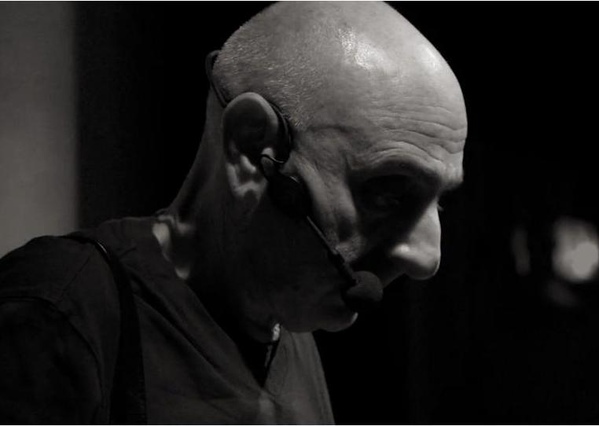
| Photo: Mike Greenberg, 2001. |
In the early 1960, as a high school student, Philip began to produce a series of concerts at McNay Art Institute, in San Antonio, TX, and that included pieces from American composers John Cage, Richard Maxfield, La Monte Young, Terry Riley, and some of his own works. Right after that, Mr. Krumm moved to Ann Arbor, MI, to study at University of Michigan. In Ann Arbor, he joined Robert Ashley, Gordon Mumma and other composers from the ONCE Festival/ONCE Group, one of the most important groups to the avant garde scene in the USA!
In the second half of the 60s, he started a light-show company in Texas, and also managed two rock bands, "Rachel's Children" and "The Children". He also was a close friends with some of the most important rock musicians in the world, Roky Erickson, Stacy Sutherland, and Tommy Hall from The 13th Floor Elevators!
Since 1982 Philip Krumm has run Clipper Ship Book Store, in San Antonio, TX. As you will check out during this interview, some of Mr. Krumm's early electronic works are being prepared to be released in LP, via Idea Records, the same label that released his piece "Formations" in 2003, in CD format.
My first contact with Mr. Krumm was via his official Facebook page, some months ago, when I invited him to this interview, which he kindly accepted! So, here's the interview!
 |
| Photo: H. Ramsey Fowler, 1962. |
PHILIP KRUMM - I was two months premature and it resulted in a number of infant ailments, some of which dragged on for a while, which made me non-athletic and drawn to music and literature, quite early. My parents bought me popular kid record albums of the day, like "Rusty in Orchestraville", which introduces kids to the instruments of the orchestra, or "A Trip Through Melodyland", which utilized many popular classics, like 'The Swan', or 'In The Hall Of The Mountain King'. Also, simultaneously, they gave me my first symphonic work: The Firebird Suite, with Artur Rodzynsky and the CBS Orchestra, as I recall. Four sides of twelve-inch 78rpm records. I loved it most of all, and soon (age 5 or so) very into classical, jazz and popular music since all were available to me either on records or radio. And radio played a very big part, since it was a big deal when I was a kid and for many years afterward, and lots of symphony concerts were broadcast as well as the Metropolitan Opera, which was about the same age I was. Thanks to the remarkable parents I was drenched in good music early on, and I was able to read the newspaper by 4 or so, so lots of good reading was around for me as well, since my parents were active readers with lots of great books. My first instrument was the piano, and I'm still trying to get the hang of it.
 One thing worth mentioning is in regard to the "Rusty in Orchestraville" recording: The story is that Rusty meets and is able to talk to various instruments of the orchestra. What I didn't know then but was delighted to discover later on is that the talking instrument effects were one of the first uses of the ring modulator. My first contact with one was much later at the Ann Arbor Cooperative Center for Electronic Music, which Gordon Mumma and Robert Ashley had slowly created. It allows one to input two different sound sources which it splits into what are called "sum and difference frequencies" and recombines them alternately. Thus, a reader can speak dialogue into a microphone, and a trumpet player can play imitative vocalized-trumpet sounds, and the ring modulator will give you a talking trumpet. I guess there wasn't a lot more to do with ring modulators in the 1940s.
Later on, by high-school or so, I became assistant to the librarian for the San Antonio Symphony. This would be during 1958-60. I set up the stands for rehearsals from time to time and got to hear great pieces in sectional: the Prokofiev 5th Symphony, for instance, with just the winds, brass and percussion, later in the week with just strings, and once with everybody, and then the actual concert. You can get to know a lot of great music this way. Worked at the SA Opera, too, and got to meet many of the stars of the day, most importantly for me, George London. He signed the several LPs of Mussorgsky song cycles that he had recently released. I got to see him do "Boris Gudonov" and "The Marriage of Figaro". All in all, a very musically beneficial time of my life. I heard lots of great classical music played live and up close for two or three years, and it had profound effects on my sense of musical experience. I was a truly lucky teenager.
ASTRONAUTA - And how about your first contact with the avant garde and electronic music?
PHILIP KRUMM - Actually, this was during some of the same times. By 16 or so I'd moved musically through the post romantics to the moderns, heavily into Schoenberg right away, loved atonality and serialism. It seemed to me that atonality was the natural evolution of the extreme chromaticism of the late 19th and a tiny bit of the 20th century. It felt quite natural to me. And by 1960, when Cage electrified so many of us when his incredible "Indeterminacy: New Aspect of Form in Instrumental and Electronic Music" LPs came out on Folkways Records, it was all over. We could see the future transformed before our eyes and creativity went wild. Like Morton Feldman said, "Now that everything's so easy, there's so much to do."
And, it would be unfair to forget the influence of one of the LPs I got from the Louisville Orchestra in 1958 which brought me Elliott Carter's brilliant "Variations for Orchestra". It was certainly one of the most important 20th-Century works for me in those days, and when I went to Michigan to school I took the recordings and miniature score with me. Ross Lee Finney know it was important and I and my fellow students, which included Roger Reynolds and Bob James, spent one session analyzing it in the graduate seminars. We studied all the Beethoven string quartets, some Luigi Dallapiccola, and best of all, Webern's Piano Variations.
ASTRONAUTA - In the late 50s and early 60s you organized concerts at McNay Art Institute. What was the best (and the worse) part of organizing avant garde concerts at that time? Are there any recording or films from some of those concerts?
PHILIP KRUMM - I look back on those concerts with amazement. It seems incredible that we were able to pull together such wonderful musicians, all in their late teens and early twenties. The concerts went by in a blur and at the present time I have no particular memory of anything problematical. There was a great older guy then named Bill Case who had a high-dollar store selling quality phonographs and stereos. He provided, and operated, the reel-to-reel player for Richard Maxfield's tapes, one of the best of the day, though I forget at the moment the brand. I remember Bill Case mentioning the addition of a "bridged center channel a la Klipsch." Maxfield required that we return the tapes, naturally enough, since there were no recordings of his works at that time. Anyway, the sound was terrific with Bill's speakers. It was a great concert all around.
Another day that stood out was Robert Sheff performing the Sonatas and Interludes for Prepared Piano by John Cage. He was already pretty virtuosic by then and he knocked out those wonderful pieces very smartly. He also, I believe, premiered a Cage work, though we didn't know it at the time. And it was an honor to have Philip Corner stationed here at Fort Sam Houston. He brought so much to us that we hadn't known before, as did his wife Styra, a cellist. They were great folks who taught us a lot. We did other concerts at McNay too, including a performance of Terry Riley's "Envelope".
ASTRONAUTA - In the early 60s you moved to Ann Arbor, and joined the ONCE Festival/ONCE Group staff (ONCE was a great watershed in the USA avant garde music history, sowing the seeds for a whole generation of composers at that time.) What was your first contact with the Ann Arbor-based avant garde artists? And how do you relate the Ann Arbor-based scene to the concerts that you organized at the McNay Art Institute?
PHILIP KRUMM - I'd done music for some productions at the Fort Sam Houston Little Theatre in 1960 ("Taming of the Shrew", "Dracula") and the director was a man named Bill Larson. I got along fine with him (not being an actor) but actors had a very, very different take on him. Anyway, he'd been a music major at the University of Michigan and had taken courses with Ross Lee Finney and suggested that I send some of my music to him. I did so, and Ross Finney responded very pleasantly ("I don't know what we're going to do with you but we want you here!"). My parents borrowed $300 from a rich uncle (who required that they repay him in installments) and I was soon on a train to Michigan. I got there with $39 in my pocket. The Dean of the music school took an interest in my case, and they set me up for residency at Nakamura Co-op, an old two-storey building which was cooperative housing for low-income students. It was a great place, with lots of smart guys, and lots of lively political ideas which I immediately took to.
 Finney told me to look up Robert Ashley and Gordon Mumma, which I did. They had differing opinions on Finney, who was way too conservative (even though he was a serialist of sorts) for them. Gordon called him "Horse Pee Funny". Ashley was more discreet. Anyway, when they saw what I'd managed to do with the McNay concerts, I was welcomed into the fold and began making music at the brand-new Cooperative Center for Electronic Music. And I was able to perform in the 1962 and 63 ONCE Festivals. In the latter Festival I performed under John Cage's direction in a performance of Toshi Ichiyanagi's "Sapporo", a work I've played in about three times. And, of course, I received a wonderful performance of my "Music for Clocks" by the Once Chamber Orchestra. I also did a theatre piece of mine called "May 1962".
ASTRONAUTA - In 1961 you took part in a Yoko Ono performance, at the Carnegie Hall, NYC. What are your memories from that event, and from Yoko Ono as a person?
PHILIP KRUMM - I only was around Yoko at that performance for maybe an hour or so, but she was totally nice to me. She was living with Tony Cox at that time, who was a nice guy with a pleasant personality and good sense of humor (and occasionally, some excellent pharmaceuticals). He visited me in Ann Arbor once, also. I'd been to La Monte Young's apartment (he greeted me from his bathtub) and his girlfriend at the time was the wonderful poet Diane Wakoski. She was very kind and nice to me and took me around NYC to meet people, and that was how I wound up at Yoko's concert. This was Thanksgiving weekend of 1961. Diane introduced me to Yoko who asked if I'd like to perform. My great friend from several years of art-correspondence, George Brecht, was there and he and I, along with the incredible sax player Terry Jennings, provided the music for her poetry reading. Yoko sat on a toilet as she read her own poetry. George and I had strings of tin cans tied to our ankles and made various vocal sounds, and Terry played enormous chords on his saxophone. Now and again Tony Cox, in a backstage bathroom, would flush a toilet while holding a microphone over it and giant toilet-flushes emitted from big speakers onstage. It was wonderful. And, of course, this same weekend I was at Cage's little house in Stony Point, when he gave me a copy of "Silence", which had just then been published. He picked a copy out of a box of them in his station wagon, unwrapped the brown paper around it, and presented it to me. When I asked if he'd write in it for me he said, "Write in it? I just wrote the whole book!" He had probably the best sense of humor of all the composers I've met. I was laughing with him most of the time I was there. A truly great man.
ASTRONAUTA - Before joining the Grateful Dead, Tom Constanten and Phil Lesh were active in the avant garde music field, like some other artists that moved from (or linked) the avant garde scene to the emerging psychedelic-pop-rock scene. And, of course because some of the main (or some of the most famous) psychedelic rock bands came from San Francisco, the city seems to be a sort of intersection point between the avant garde arts and the rock scene. What was your relation with the San Francisco avant garde and electronic music scene in the early 60s, did you have any contact with the San Francisco Bay area composers?
PHILIP KRUMM - Larry Austin was my contact with west coast musicians. I was lucky enough to work with several wonderful people including (Dary) John Mizelle and Art and Pat Woodbury (who performed as "Billie Alexander"). They and a few others constituted the New Music Ensemble (NME) and they did a bang-up excellent premiere of my "Sound Machine". I was only at Davis for six months when circumstances dictated that I get back to Texas. It was a difficult period for me, but the Davis musicians were wonderful. I went to San Francisco with friends to see a premiere of Morton Subotnick's "The Tarot", a work with music and projections. It was enjoyable but when I met him again years later he said that he'd withdrawn it. I also lucked into a Muddy Waters concert at the Avalon. There were important rock concerts at UC Davis that I was also lucky to enjoy: The Jefferson Airplane, Big Brother and The Holding Company, and The Grateful Dead all did very engaging concerts. My only time, I think, taking part in a several-hundred person snake dance. Fantastic.
ASTRONAUTA - And how about the Texas rock scene? You've managed rock bands for a while, and also had a light show company, in the 60s, right? What was the link between avant garde arts and psychedelic rock music in Texas, at that time? Were you in contact with Roky Erickson, Tommy Hall (13th Floor Elevators), and other rock bands from the 60s? And how about another Texas' psychedelic rock band, with avant garde influences, Mayo Thompson's Red Krayola?
PHILIP KRUMM - I met the 13th Floor Elevators early on, right when their first 45 of "Tired to Hide" and "You're Gonna Miss Me" came out, about 1964. They were all very smart and interesting people and I kept in touch, aperiodically, until the very end, which I happened to be around to see, even be part of. Roky had gotten to be pretty far out by 1968 - a very important year for many of us - because of all the acid, etc., that he'd consumed during the previous 'sixties. One of my mostly volunteer jobs at HemisFair, San Antonio's world's fair which was going on then, was as a concert organizer for the Youth Pavilion, and we did a lot of excellent concerts, including the Elevators. But across the street from HemisFair was a rock bar which had a sister venue in Houston. The manager was - at first - a rude and obnoxious fellow who treated all musicians like cat litter, felt they needed to be kept in their place. The Elevators were scheduled to play there on a Saturday night, but no one mentioned that to me. Roky'd made friends with a wonderful Vietnam vet named Charlie Powell, who was heavily - as we said at the time - shell-shocked, now under the blanket PTSD. They were both too damaged to communicate effectively with most of us, but got along excellently with one another. I had a Cadillac hearse at the time that I'd bought while in California in 1966. Charlie and Roky showed up and asked if they could borrow it to go to Austin. I said Of Course and off they went.
Only minutes later Tommy Hall showed up looking for Roky. They were scheduled to perform at the rock club and the manager was already in a bad mood and now Roky was obliviously headed for Austin in my hearse. Tommy said, "without Roky, we're screwed." I went with Tommy to the rock bar and watched him endure the indignities of the hot-headed and verbally abusive manager, happy to chew out and insult the most rugged and extraordinary rock group Texas ever produced. I had an occasion to see him later in the year. He said he felt badly about how he dealt with them but his experience dealing with bands over the years made him see them as mostly stupid cattle.
That was the end of their concert work together. I heard about an Elevators gig happening in Ingram a year or more later at the Old Dog Saloon but when I got there it was just Roky and his friends, no Elevators at all. I politely indicated that this was bad form and he shouldn't pretend to be the Elevators. I think he already knew this and I just reinforced it a bit. He never did that again. I should say also that no matter how zonked out he was, or how straight, he always remembered me and my name, which was always wonderful and surprising to me. He was always, and remains, a good guy.
Actually, the Elevator who kept in touch with me the longest and spent the most time talking to me about them and their experiences was Stacy Sutherland. He was very smart and literate and had a great way of parsing out the history they'd all passed through during the turbulent 'sixties. He was responsible for the final album "Bull of the Woods" getting out at all; he did most of the production work on it and wrote much of the material. He'd promised that he'd bring me a lyric sheet for it since some of the words are hard to make out but - as many people had feared might happen - his wife shot and killed him before he could make that visit. It was a sad and stupid loss of a nice guy and good friend. He's buried at Center Point.
To answer your question, I didn't know the Krayola folks but liked their album. I know lots of the bands of the era, Bubble Puppy, Jay Hoyer, more that I can remember right now. It was a wonderful period of my life.
Of course, I managed (in a manner of speaking) two excellent rock bands, one called "Rachel's Children" and the other called "The Children". They were (except for an occasional drummer overlap) unrelated groups, and were already named when they found me. Rachel's Children were genuine artists, brilliant musicians, and very inventive, but somewhat lacking in professional stamina. When they didn't want to play, they didn't play, but they rarely took gigs that they wouldn't do. The Children, on the other hand, were totally devoted and could do concerts even when very sick. They later wound up with Lou Adler who got them an album on a major label ("Rebirth" on Atco. CD reissue on Gear Fab.) They deserved the recognition they got, and more. Two of them died early, Steve Perron and Bill Ash, both wonderful guys and fine musicians. And the singer Cassell Webb, was and remains beautiful and gifted. Rachel's Children made some wonderful recordings. They wound up in the possession of famous author William F. Brammer ("Billy") who greatly admired the group. One day he told guitarist Don Harding (who also died young) that he (Brammer) was the only person he know of over 50 still shooting speed. Three weeks or so later he was dead, and the tapes disappeared with him. I'd met Bill Brammer while working at HemisFair where he was in some top-level position. He had a best-seller novel a few years earlier called "The Gay Place" which wasn't about anything gay but was actually a fictionalized history of Lyndon Johnson. I noticed that after Bill died the publishers reprinted "The Gay Place" in a lovely trade paperback, under the name "Billy Lee Brammer". This was annoying to me. At no time during the two-and-a-half years that I was around him did anyone ever call him "Billy Lee". He published the book as "William F. Brammer". I believe that the "Billy Lee" name is a publishing gimmick to make him seem more Texasy. But it's a good book, nonetheless. And Bill' was a sad loss to lots of us who knew him.
My lightshow company was called "Light/Sound Development" and utilized many good friends, like David King, a talented visual artist, Richard Moore, Pat Finch and others. I'd seen the light-shows at the Avalon and Fillmore, but major influence was the much earlier Ann Arbor Space Theatre created by Milton Cohen. Ashley, Mumma and I had done music for his overwhelmingly beautiful multi-projection light shows. When I returned to Texas from Michigan I immediately (1963) began constructing a turntable-projection system based on Milton's, and was helped by one of San Antonio's native geniuses, Charlie Winans. We put together a fabulous turntable covered with fixed and spinning mirrors, systems of prisms, and an artfully constructed mirror ball in the middle. The turntable was surrounded by film and slide projectors and various light-projection sources, all aimed into it, and the dazzling light-splaying effect on any given environment was quite psychedelic and original to us. But we also had overhead projectors too, and could produce a fine lightshow. We worked the opening of San Antonio's first psychedelic club, "The Mind's Eye", and The 13th Floor Elevators and Rachel's Children played also. But a crowning achievement was a concert Rachel's Children did late in HemisFair at the Youth Pavilion. We had so much equipment at our disposal: seven or eight overhead projectors, four film projectors, a stereo slide projector as well as standard ones, and our central lightsplayer. The band was amazing that night and our lightshow guys were in top form, and it became one of the most astonishing musical-techno-cultural alterations of collective reality where all the participants were, for a few minutes at least, totally united in a transformative experience. When it ended my Youth Pavilion supervisor looked at me with a dazed expression and said, "That was the most amazing damn thing I've ever seen!" And it was, as we all knew it. It was one of those events that makes a life in music and concerts so incredibly wonderful, mostly because it happens so rarely.
I can't leave these Texas Music memories without a mention of the incredibly ingenious Jerry Hunt. We met at Roger Shattuck's 'Pataphysics Festival in late spring or early summer of 1963. I'd met Roger a while before when he'd invited me to dinner at his home with his wife and I gave him a copy of my board-game composition, "Lincoln Center". Later he invited me to the Festival and I performed a piece of my own and Gordon Mumma's "Four Part Music". I met Jerry after his surprising performance and we became immediante friends. A truly bonding experience was a truly grueling trip in his Renault Dauphine (with the back seat full of electronic equipment) to Brandeis University where we did a heavy-duty concert with Alvin Lucier. The concert was wonderful but the trip was a horrorshow, best detailed at another time. Jerry and I did many more concerts together as well as a TV program for KLRN (1964) which was simulcast on the radio, and stayed in touch until shortly before his suicide. It was a painful loss and I can still hear his very distinctive voice from many long and interesting phone calls in the intervening years.
ASTRONAUTA - How it was your first contact with Electronic Music Synthesizers, especially with the Moog Synthesizer?
PHILIP KRUMM - The first synthesizer I got to use was a little Buchla at UC Davis. It had no keyboard, only plugs and patch cords. I set up some simple rhythm patterns and recorded them and wound up selling them, sinfully cheaply of course, to an agency doing commercials for Volkswagen. I heard some of my material on the radio from time to time. I used, surreptitiously, a couple of synthesizers at Trinity University here in San Antonio: one was an Electro-Comp, which had a keyboard printed on the lid of the synthesizer. Jerry Hunt had some Moog filters in his studio which I used a couple of times. I met Bob Moog when Alamo Piano Company brought him in for a lecture-demonstration, probably about 1969. But I never used a Moog itself. I got a gig (1967?) playing in a Christian rock cantata thing called "Truth of Truths". They let me have a nice ARP synthesizer for about six weeks before the concert. I recorded a lot of material with it and most of which I still have. ARP was probably my all-around favorite of all the early synthesizers I used. Not a happy worshipper myself, the concert was a bit of a challenge for me; but all I had to do was play a little electronic sound behind "God"'s voice now and then. "God" was played by a big-time Baptist preacher in San Antonio named Buckner Fanning.
ASTRONAUTA - What are your memories on meeting and studying with Karlheinz Stockhausen in the mid-60s, at UC Davis?
PHILIP KRUMM - Stockhausen was a bright spot in a difficult time for me. This was the summer of 1966. I'd been invited out to UC Davis by a prominent composer on the faculty there. A friend and I drove to California in my Corvair, which had to be held in 3rd gear with a bicycle inner-tube attached to the seats. The trip was a horrorshow in itself, but when I got there and found that no music department assistance was available, things got tougher. I got to meet Stockhausen when Bob Ashley was visiting Mills College. He took a liking to me, I guess, and invited me to have lunch with him. We talked mostly about the Ann Arbor experience a few years earlier, and walked for a while talking about composers I' met. He told me he wouldn't mind if I audited his lectures, since I'm come all that way and couldn't get school assistance.
I managed to attend a few of his lectures before I had to return to Texas. He discussed his major compositions and how he made them, chiefly "Carre" and "Kontra-Punkte"; "Mikrophonie 1" had just come out on a Columbia LP, and he discussed the making of that enormous work. Then, time and money ran out and I had to return home. I saw him in Clear Lake City a few years later for a performance of "Sirius" with Markus on trumpet, a wonderful program. I went to talk to him after the concert, told him that I'd driven up from San Antonio to see him. He grasped my hand warmly and said, "You are an angel!"
ASTRONAUTA - In your interview with Josh Ronsen you've mentioned that you have recordings of some of your pieces, performed at ONCE Festival and ONCE Friends, that aren't on the Box Set released in 2003 by New World Records. Do you have plans to make this "extra" recordings available?
 PHILIP KRUMM - There'a a recording of the piece I consider my opus one, if I used opus numbers, which I don't. It's called "Paragenesis", for two violins and piano. It was performed and recorded at a "Once Friends" concert by Karin Fierce, Lana Nail and Larry Leitch. I guess it'll turn up someday. Also, New Albion recorded the concert with the premiere of my "Banshee Fantasia", which was commissioned by the Bay Area Pianists in 1996 in celebration of Henry Cowell's 100th birthday. It was played by "Blue" Gene Tyranny between two different versions of Cowell's "The Banshee". I imagine that that album will be released someday. Also, at the time of this writing, Idea Records is preparing an LP of some of my early electronic works, one of which was made in Gordon Mumma's Ann Arbor studio. Idea does beautiful work, and have released my "Formations", a work I made using star maps back in 1962. "Blue"'s wonderful recording was in bad shape before it got translated into digital format, but the result knocked me out when I first got the master disc. There are, at my home, some tapes of early works such as the score for "Taming of the Shrew", a flute and piano sonata ("Autumn Sonata") which is written so that the flutist can accompany himself, and a few early orchestral pieces. I have no idea of the condition of the tapes. I hope they can be properly copied someday. Opus One release Scott Vance's recording of my Bass Clarinet Concerto, under the direction of the marvelous Barney Childs. There's also a fine recording by Martin Walker that I hope sees release someday. And I own a tape of the concert Jerry Hunt and I did with Alvin Lucier and the Brandeis Orchestra in 1963. That would be an interesting historical document to release someday.
ASTRONAUTA - Well, that's it, sir. Thank you so much for your time and for accepting my invitation for this interview!
PHILIP KRUMM - Thank you, Fabricio. I'm grateful to you for giving me an opportunity to solidify some important memories. I hope that not too much suffers in translation; there'll probably be some problematical moments. I'm interested in seeing how interesting these brief historical remembrances might someday be.
Philip K.